On 25 to 26 June, Fraunhofer SCAI organised a final symposium of the JPND – EU Joint-Programme Neurodegenerative Disease Research funded ADIS project in close collaboration with its international consortium members, leaders of related initiatives as well as industry representatives.
The symposium was titled “Towards Earlier Diagnosis of Alzheimer’s Disease” and took place at Schloss Birlinghoven, Fraunhofer IZB Campus, Sankt Augustin. It offered a platform for knowledge exchange and to identify research priorities for future collaboration opportunities, while underlining the work done as part of the project.
The first day started with a review of current research on early Alzheimer’s disease diagnosis and biological characterisation from a clinical, biological and computational side. “Importantly, we see the challenge of early diagnosis from a technology-agnostic point of view. That means, the focus is not only on blood-based biomarkers, but also includes modern digital device technology, which could be potentially used in an at-home setting to monitor cognitive function, sleep disturbances or behaviour and may thus serve as ‘digital’ markers of disease-associated symptoms,” said project coordinator Holger Fröhlich from Fraunhofer SCAI.
The programme on the first day was divided into four sessions. After a welcome and introduction on the ADIS project by Holger Fröhlich, the opening session “Early Diagnosis of Alzheimer’s Disease – The Perspective” set the stage. Raquel Sanchez-Valle (Hospital Clinic Barcelona) presented an overview of the ADIS clinical study, followed by introductions to three Innovative Health Initiative-funded research projects.
Linus Jönsson (Karolinska Institutet) gave an overview of the PROMINENT project which is creating a digital platform for precision medicine to improve the diagnosis and treatment of neurodegenerative disease and co-morbidities. Ruth Stephen (Karolinska Institutet) and Matt Clement (Gates Ventures) presented the AD-RIDDLE consortium and platform aiming to transform how Alzheimer’s disease is detected and diagnosed, prevented and treated across healthcare settings. This was followed by an online talk by Dag Aarsland (King’s College London), coordinator of the PREDICTOM project. The goal of the PREDICTOM project is to develop a screening platform capable of identifying people at risk of dementia, before the first symptoms appear.
The second session, chaired by Raquel Sanchez-Valle, focused on “Immune Profiling and Single Cell Sequencing of Blood Cytotoxic Lymphocytes”. Anna C. Aschenbrenner (German Center for Neurodegenerative Diseases) opened the session with an invited talk on peripheral immune cell alterations in Alzheimer’s disease. This was followed by presentations from Kuti Baruch (ImmunoBrain), who outlined the immune profiling efforts and how findings may support future stratification of patients for immunotherapy trials; Sarah Hücker (Fraunhofer ITEM), who introduced the laboratory pipeline for single-cell sequencing in ADIS; and Sophia Krix (Fraunhofer SCAI), who presented AI-based analyses of single-cell RNA sequencing data, highlighting the role of machine learning in capturing individual-level biological patterns.
After a lunch break, the third session on “AI and Agent-Based Modelling for Biomarker Discovery and Risk Profiling” was chaired by Kuti Baruch. Sophia Krix discussed AI-based modelling of ADIS single-cell RNA sequencing data, showing how machine learning can link sleep disturbances, immune measures, cognition and brain pathophysiology; followed by Shir Bahiri (Tel Aviv University), who introduced agent-based modelling to simulate immune responses to a candidate drug and help identify likely patient responders.
The final session of the day, chaired by Stefan Kirsch (Fraunhofer ITEM), focused on digital biomarkers. Victoria Brugada presented Altoida and its integration in ADIS. Sophia Krix returned to present AI-based modelling of sleep data in ADIS. The session concluded with Uri Nevo (Tel Aviv University) introducing the BHQ app for behavioural monitoring. The application allows passive data collection of mobile phone usage, such as calls, location or app browsing. This anonymised data is analysed to detect deviations from an individual’s routine, which may help identify early signs of behavioural or cognitive change.
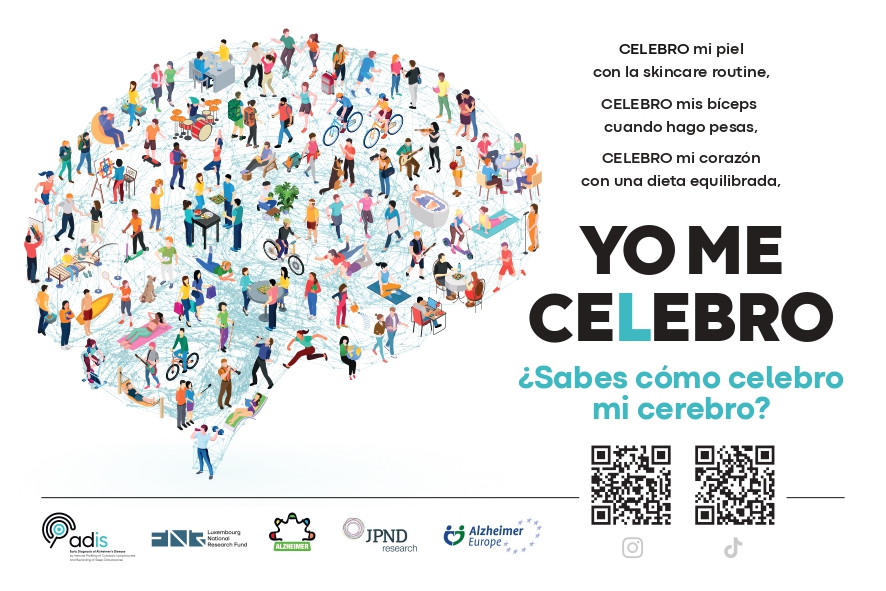
The second day was devoted to disease prevention strategies and future collaboration. The morning session, chaired by Raquel Sanchez-Valle, was titled “From Early Diagnosis to Disease Prevention”. It included an invited talk by David Bartrés-Faz (University of Barcelona), who gave an overview of their research on brain health, including the Barcelona Brain Health Initiative (BBHI), which is an initiative aimed at knowing and understanding how to maintain the health of our brain. This was followed by an introduction to the PatternCog project by Ruth Stephen (Karolinska Institutet). The overarching goal of this project is to improve dementia prevention strategies by developing support tools for the detection of earliest signs of impending cognitive decline which would allow early and personalised multidomain interventions. The session concluded with a presentation by Soraya Moradi-Bachiller (Alzheimer Europe) on the development and launch of a brain health campaign for young adults in their early 20s.
This was followed by round table discussions on five key questions:
- How to mitigate the decades-long gap between Alzheimer’s disease triggers and symptom onset?
- Which early biomarkers are most useful in terms of cost, scalability, sensitivity and specificity?
- How to translate early biomarkers into approved medical products with clear value for patients, clinicians and payers?
- At which stage of the patient journey should such products be implemented?
- How to design better-targeted dementia prevention programmes using modifiable risk factors?
Each group shared a summary of their discussion, followed by a closing session chaired by Holger Fröhlich reflecting on next steps for potential follow-up collaborations.
The symposium also showcased the distinctive contributions of the ADIS project. “ADIS is, to our knowledge, the first Alzheimer’s study to explore the peripheral immune system on the single-cell level with such depth in a sizeable patient group, while also integrating high-resolution digital, cognitive and sleep data,” said Holger Fröhlich. This multimodal approach offers new possibilities to understand the interplay between immune function, sleep disturbances and cognitive impairment in Alzheimer’s disease, with the potential to support earlier diagnosis.
All data from the 75 patients were managed according to the FAIR principles and integrated into the ADataViewer catalogue developed at Fraunhofer SCAI. This allows researchers to explore the available data modalities and request access via appropriate channels.
The ADIS consortium would like to extend its gratitude to the Fritz-Thyssen Foundation for the financial support of this event.
Find out more about the project: https://adis-project.eu/
Visit the ADataViewer: https://adata.scai.fraunhofer.de/